Roots of Her – Women Who Enable: Dr. Shivani Asabe, Turning Knowledge into Opportunity
Roots of Her | Women Who Enable | Solapur, Maharashtra
In Akola Wasud, a village in Sangola taluka of Solapur district, a region long known as drought-prone, a once-dry landscape has become a hub where farmers learn, test and grow. At Rukmini Farm & Nursery, new crops are tried out, new methods are demonstrated, and every day 20 to 25 farmers arrive with questions and leave with answers.
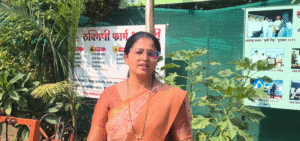
At the heart of this effort is Dr. Shivani Mahesh Asabe, Director at Asabe’s Growntree Private Limited and Scholar Script LLP, and a woman who enables others to grow.
Where the Journey Began
For Dr. Shivani, the path into agriculture began with education, inspired early on by her father’s deep devotion to the family’s ancestral farm. “With a strong desire to make a meaningful impact in farming, I enrolled in B.Tech Agricultural Engineering,” she says.
An M.Tech in Process and Food Engineering followed. While studying the sector, she noticed that farmers were skilled at harvesting good produce, but value addition through processing was the missing link. That realisation led her to complete a PhD in Food Engineering. Today, alongside her husband, she works across farming, export and food processing.
A Turning Point in Israel
During her B.Tech, Dr. Shivani joined a one-month agricultural training programme in Israel, an experience that changed her perspective on farming. Climatic conditions there are harsh and water is scarce, yet Israel is a global leader in agriculture, achieving outstanding yields through innovative techniques and carefully chosen crop varieties.
Returning home, she saw India’s potential differently. “India’s geographical conditions are naturally suitable for a wide variety of crops,” she says. Farmers, she realised, are skilled at harvesting, but “we need to bring some changes to our farming practices and focus on value addition.” She calls it “a major turning point in my life.”
Starting with Oneself
The question after returning was where to begin. The family strongly believed that change must start with oneself, so they created their own demo plot and began working with different crop varieties. The entire farm was converted to drip irrigation, making water management far easier.
They also built a multi-cropping system so that the farm harvests something nearly all year round: dragon fruit from June to November, apple ber until February, then mango, followed by guava. This keeps cash flow steady, and if one crop suffers from weather or market price swings, another provides stability. Dragon fruit is cultivated across 22 acres, guava is grown in several varieties, and a trial plot for longan has been set up.
Rukmini Farm & Nursery: A Living Laboratory
Rukmini Farm & Nursery is far more than a farm. It hosts a wide range of exotic fruits, including Abiu from Brazil, Macadamia, Yellow Dragon Fruit, Avocado, White Jamun and Seedless Jamun, along with seven to eight mango varieties such as All-Time Mango, Red Ivory and Black Kasturi.
The purpose is practical. Varieties are trialled to see which thrive in the local climate and deliver good yields and quality, so that the most suitable ones can be recommended to farmers.
Learning from Vietnam, Sharing with Farmers
The family started dragon fruit farming in 2013, when the crop was completely new in India and few knew how to cultivate it or how long it took to bear fruit. To learn, they travelled to Vietnam, a global leader in dragon fruit production and exports, and stayed at a farmer’s home for a week. They studied cultivation, harvest stages, post-harvest handling and marketing.
Back home, they set up dedicated one-acre demo plots showing ideal spacing, variety selection, and trellis versus pole methods, so that any visiting farmer can have their doubts answered on the spot. As yields rose, a new challenge emerged: when large volumes reach the market together, prices crash. A second trip to Vietnam to study post-harvest management led them to build their own cold storage facility, holding produce during market gluts and releasing it when supply drops. “By managing the supply chain this way, we consistently secure ₹20 to ₹30 more per kilogram compared to the prevailing market rates,” says Dr. Shivani.
This knowledge is passed on through workshops on dragon fruit, guava, apple ber and other crops, on-field sessions covering plant care, fertilisers, farm development, harvest timing and value addition, and through the family’s YouTube channel and social media.
Inspired by Family
Dr. Shivani credits her in-laws and her husband as her biggest inspiration. Her father-in-law, thinking well ahead of his time, introduced apple ber cultivation in Maharashtra in 2009 and began producing quality saplings for other farmers. After that success, he introduced dragon fruit in 2013. “Turning this dry region into the thriving oasis that Rukmini Farms is today is entirely his credit,” she says.
Drawing on that example, the family now combines academic knowledge with field experience to explore new varieties, including a new apple ber variety that grows to the size of a green apple and is still under study. The approach is consistent: test first on their own plots, analyse yield and quality, and only then guide farmers. They assess a farmer’s soil type and water availability, recommend a suitable crop, and offer end-to-end guidance on plantation methods, plant spacing, irrigation scheduling and watering intervals.
The Change She Hopes to See
Looking ahead to the next ten years, Dr. Shivani hopes for three shifts in agriculture:
- Women in leadership. Women contribute significantly to agriculture, but their role is often limited to daily farm activities. She wants to see them lead, make decisions and build identities as agri-entrepreneurs.
- Fair value for farmers. Farmers grow crops “as precious as gold”, yet prices are decided by others. A marketing system and supply chain should ensure fair returns.
- Value addition. Farmers should look beyond raw produce to minimal processing so they can secure better prices on their own.
“My family and I are continuously working toward making farming profitable and developing a thriving agricultural ecosystem,” she says.
Dr. Shivani’s story shows that enabling others is as powerful as growing crops. By testing, learning and sharing openly, she is helping farmers around her turn knowledge into better yields and better prices.
Roots of Her is a Rovensa Next APAC initiative that celebrates the women behind agriculture, highlighting their journeys, challenges and contributions that help shape a more sustainable future for farming.
https://youtu.be/ZiexXrAnOwc?si=Eh8fTQgWHl6loaiT
watch video to know Dr. Shivani’s story.